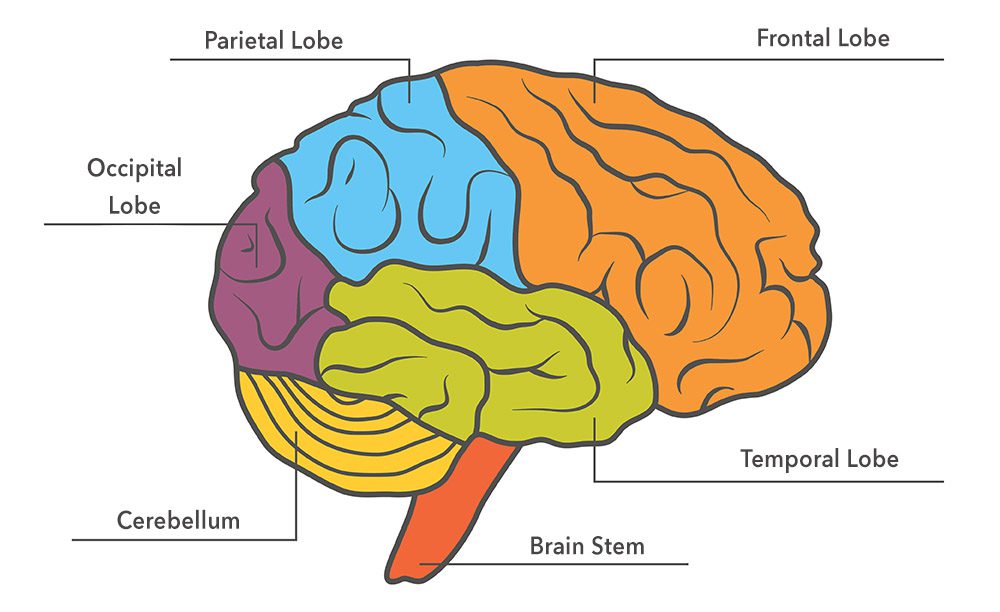
Earlier, you learned about the three main parts of the brain: the cerebrum, cerebellum and brain stem. In this section, you’ll learn more about how different regions of the brain control certain functions in the body. You’ll learn about regions of the cerebrum and the functions of the cerebellum and brain stem. Damage to a region of the brain can affect the function or activity controlled by that region.
Hover over or tap on each icon in the image below to learn more about the brain’s regions and functions.
The parietal lobes are located around the back and top of the head. They are important for:
Processing and interpreting sensory information
Awareness of our environment through physical touch
Awareness of our body parts
Spatial awareness of the world around us
The frontal lobes are located behind the forehead and are the largest lobes in the brain. They are important for:
Voluntary movement
Expressive language
Planning, organizing, self-monitoring skills
Controlling behavior and emotion
Being “home” to our personality
The occipital lobes are located at the back of the head. They are important for:
Our visual perception
Seeing and understanding colors, forms, and motions
The cerebellum is located above the brain stem and beneath the cerebrum. The cerebellum is important for:
Our body’s motor movement
Balance and equilibrium
Muscle tone
The brain stem attaches the brain to the spinal cord, allowing information to travel between the brain and the body. The brain stem is important to vital functions, such as:
Controlling the heart and lungs
Our consciousness and ability to pay attention
The temporal lobes are located behind the ears and make up the second largest lobes in the brain. There is a dominant temporal lobe and a non-dominant temporal lobe.
The dominant temporal lobe is responsible for:
Understanding language
Learning and remembering verbal information
The non-dominant temporal lobe is responsible for:
Learning and remembering non-verbal information, such as sheet music and shapes
The temporal lobes are also important in processing emotions and memory retention.